Why he is a hero
Hill 861, March 16, 1967. Every underlined phrase opens the letter, recording or record behind it.
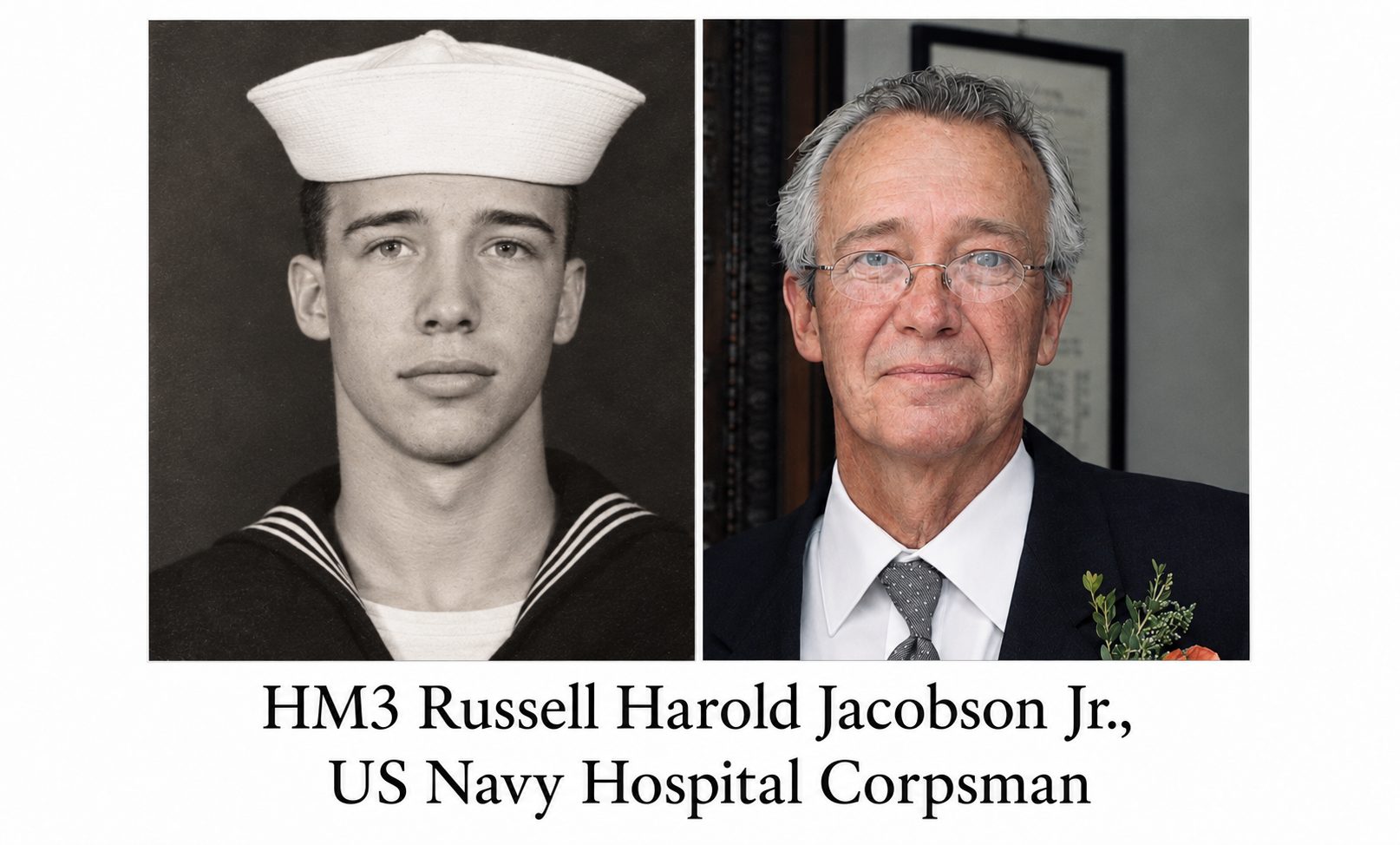
On March 16, 1967, Echo Company, 2nd Battalion, 9th Marines walked into a hidden North Vietnamese force on Hill 861, near Khe Sanh. Three Navy corpsmen were with the company on the hill that day. Two were killed. The third was Russell Jacobson, 20 years old.
As Marines went down, Russell kept running into the fire to reach them. He was hit more than a dozen times and kept going back. A historian put it in print decades later.
“Hit more than a dozen times as he raced up and down the fire-swept trail to pull casualties to safety, the “doc” had finally been felled when a slug ripped into his right hip, destroying it.”Edward F. Murphy, The Hill Fights: The First Battle of Khe Sanh (Presidio Press, 2003), page 44
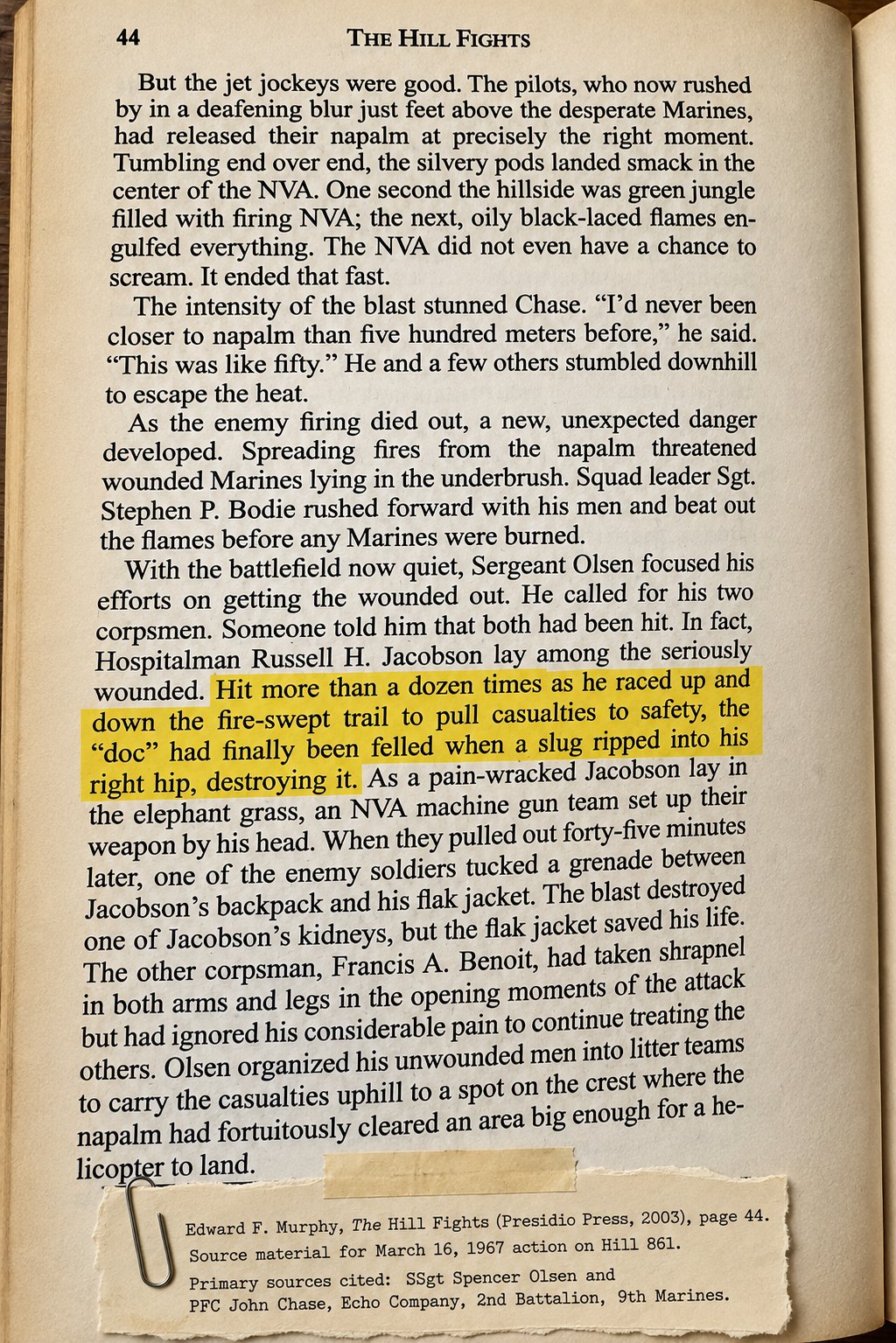
Murphy's sources for this action were Marines who were there: SSgt Spencer Olsen and PFC John Chase of Echo Company, 2nd Battalion, 9th Marines. Tap the page to read it full size.
“He went into the service selflessly and served with distinction and suffered unspeakable wounds. He certainly deserves recognition for his valor.”
Edward F. Murphy, in a June 2026 email to the Jacobson familyA shot to the hip finally brought him down. For about 45 minutes, an enemy machine gun team used him as bait to draw in the Marines coming up the trail. Wounded and pinned there, he shouted at them to stay back. The enemy left him with a grenade beneath him. It went off. His flak jacket took much of the blast, but his kidney was badly injured and later removed. Russell told the story himself that spring, in a 1967 newspaper story written while he recovered.
Believed dead
Earl "Chit" Chittenden, the best man at Russell's wedding, found him and believed he was dead. Hear Earl tell it in his own words, or read his account. Russell was loaded onto the helicopter with the fallen. He was still alive.
LCpl Herbert Thompson was hit while carrying Russell to that helicopter. Two months later, from his own hospital bed, Thompson wrote to him: "Regardless of what you think, you and only you was the fact that they made it OK."
Eight days after the ambush, Marines from his platoon sat down with a Marine Corps interviewer at Khe Sanh. The interview was classified Secret. Both squad leaders reported that the platoon's corpsmen had been killed. Sergeant Stephen P. Bodie said it plainly: "Both of our corpsmen were dead." Russell was one of those corpsmen. Listen to the 1967 recording or read the transcript.
How the recordings connect
About a minute. Earl's memory and the 1967 Marine Corps recording, side by side.
Coming home
He was treated aboard the hospital ship USS Repose in Da Nang Harbor, then spent nearly a year recovering, including at Chelsea Naval Hospital outside Boston. Earl remembers finding him there, alive. The Boston Globe named him in July 1967.
Russell came home with a Purple Heart. No valor award was ever processed. He lived the rest of his life with a fused hip, a leg brace and a cane. His wife Peg, a nurse, kept his records and fought for his care, writing to Senator Ribicoff in 1971. In 1986, Russell wrote to Senator Dodd himself, describing "multiple gunshot and fragmentation wounds to the right arm, right chest, abdomen, right hip and both lower legs."
He went to college, earned his degrees and spent decades as a physician assistant in pathology. He raised three children. He almost never talked about Vietnam. His son Dave remembers that every March 16, he looked like a ghost. Agent Orange took him on January 9, 2015, 48 years after Hill 861.
Same hill, same day
On the same hill that same day, HM3 Francis Arthur Benoit moved through open ground under fire to reach wounded Marines. He was killed, and he was posthumously awarded the Navy Cross. Russell, for comparable actions, received no valor award. The two men's fates were different, and this is not meant to equate them. It shows that this kind of courage, in this company, on this day, was recognized at the Navy Cross level when someone wrote it up.
Echo Company was operating under 1/9 that day but belonged to 2/9 on paper, and Russell was a Navy corpsman attached to Marines. In the chaos of the evacuation, writing up his actions fell into the gap. Today his family is asking the Navy to review his actions for the Navy Cross.
His story also started the Fire Swept Trail, where families keep the stories of the Vietnam veterans they love.